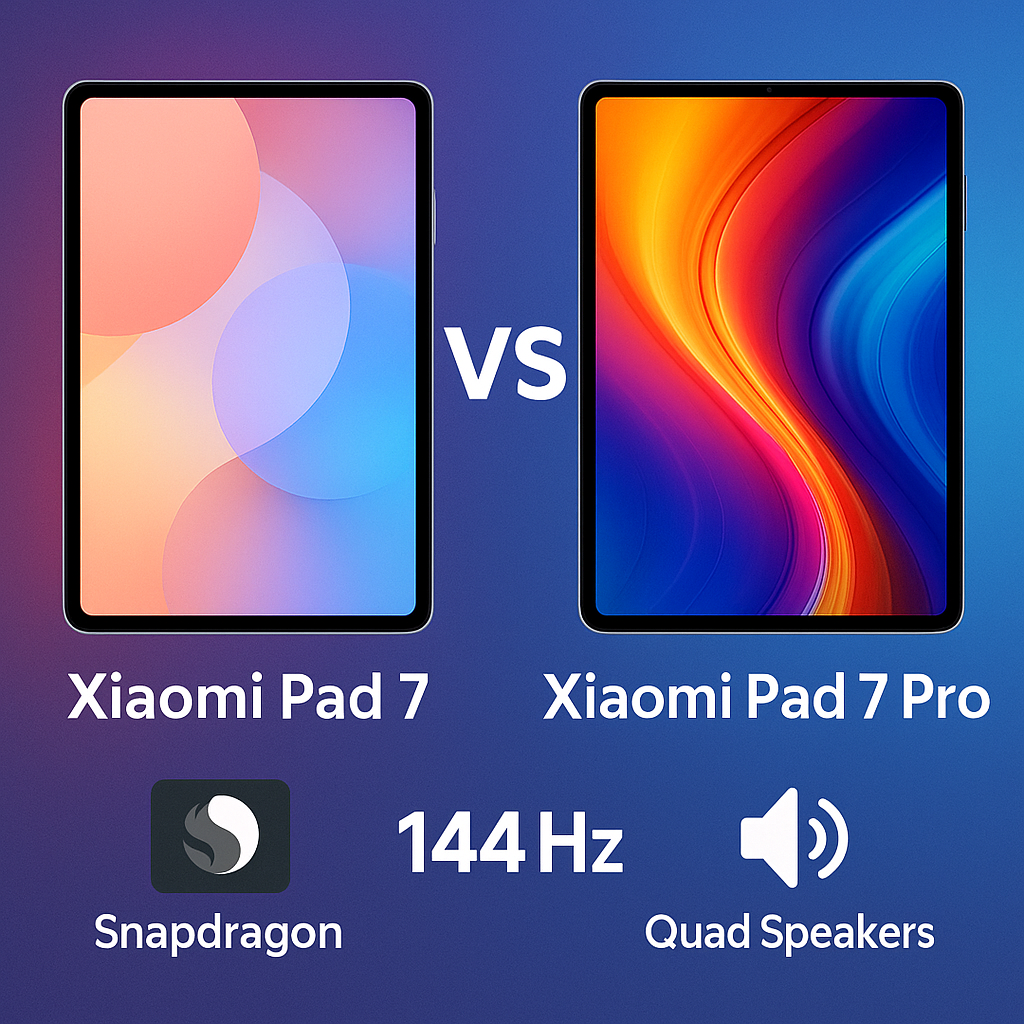
- Xiaomi Pad 7 vs Xiaomi Pad 7 Pro Comparison (2026)
- Xiaomi Pad 7 vs Xiaomi Pad 7 Pro: Quick Answer
- Xiaomi Pad 7 vs Xiaomi Pad 7 Pro: What You’ll Learn
- Who Should Buy Xiaomi Pad 7 vs Xiaomi Pad 7 Pro
- Xiaomi Pad 7 vs Xiaomi Pad 7 Pro: Specs at a Glance
- Xiaomi Pad 7 vs Xiaomi Pad 7 Pro: Key Differences
- Xiaomi Pad 7 vs Xiaomi Pad 7 Pro: In-Depth Comparison
- Xiaomi Pad 7 vs Xiaomi Pad 7 Pro: Pros & Cons
- Xiaomi Pad 7 or Pad 7 Pro: Who Should Buy Which?
- Xiaomi Pad 7 vs Pad 7 Pro: Niche Questions Before You Buy
- Does the Pad 7 Pro support the Xiaomi Smart Pen 3? What about the Pad 7?
- Which is better for gaming — Pad 7 or Pad 7 Pro?
- Do both models support Widevine L1 for Netflix HD streaming?
- Can you use a keyboard case with both models?
- Which has better real-world battery life — Pad 7 or Pad 7 Pro?
- Is there a noticeable difference in display quality between the two?
- Xiaomi Pad 7 vs Xiaomi Pad 7 Pro: FAQ
- Final Verdict: Xiaomi Pad 7 vs Xiaomi Pad 7 Pro
Xiaomi Pad 7 vs Xiaomi Pad 7 Pro Comparison (2026)
The Xiaomi Pad 7 series brings serious power into the mid-range tablet space, and the line-up is split into two clear options: the Xiaomi Pad 7 and the more powerful Xiaomi Pad 7 Pro. On paper they look very similar – same 11.2-inch 3:2 display, sleek metal design, support for keyboard and stylus – but under the hood they target very different users.
In this guide we break down every meaningful difference between the Xiaomi Pad 7 and Xiaomi Pad 7 Pro: chipset performance, display refresh rate, audio quality, battery and charging, cameras, software experience, and accessory ecosystem. By the end, you’ll know exactly which Pad 7 model fits your budget and how you actually use a tablet in 2026.
Xiaomi Pad 7 vs Xiaomi Pad 7 Pro: Quick Answer
If you want the best performance for gaming, heavy multitasking, and long-term use, the Xiaomi Pad 7 Pro is the clear winner thanks to its Snapdragon 8s Gen 3 chipset, faster display, and richer quad-speaker audio. For most casual users, students, and media consumers, however, the regular Xiaomi Pad 7 already offers excellent value with a fast Snapdragon 7+ Gen 3, sharp 11.2-inch screen, and great battery life at a lower price.
In short:
Xiaomi Pad 7 → Best value for everyday work, study, and entertainment.
Xiaomi Pad 7 Pro → Best choice for power users, gamers, and creators who want maximum performance.
Xiaomi Pad 7 vs Xiaomi Pad 7 Pro: What You’ll Learn
- The real hardware differences between the Xiaomi Pad 7 and Xiaomi Pad 7 Pro.
- How the Snapdragon 7+ Gen 3 compares to the Snapdragon 8s Gen 3 in real-world use.
- Whether the higher refresh rate and upgraded speakers of the Pad 7 Pro matter for everyday users.
- Which model is better for students, professionals, gamers, and content creators.
- The battery, charging, camera, and accessory differences that influence long-term usability.
Who Should Buy Xiaomi Pad 7 vs Xiaomi Pad 7 Pro
- Buyers choosing between the Xiaomi Pad 7 and Pad 7 Pro for work, study, or entertainment.
- Students and casual users who want a powerful but affordable mid-range tablet.
- Gamers and power users who need the highest performance available in the Pad 7 lineup.
- People deciding whether the price jump from Pad 7 to Pad 7 Pro is worth it in 2026.
Xiaomi Pad 7 vs Xiaomi Pad 7 Pro: Specs at a Glance
| Spec | Xiaomi Pad 7 | Xiaomi Pad 7 Pro |
|---|---|---|
| Display | 11.2″ LCD, 3:2 aspect ratio, up to 144Hz, 2.8K-class resolution | 11.2″ LCD, 3:2 aspect ratio, up to 144Hz, 2.8K-class resolution (better tuning & peak brightness) |
| Processor (SoC) | Qualcomm Snapdragon 7+ Gen 3 | Qualcomm Snapdragon 8s Gen 3 (flagship-class) |
| RAM / Storage | Typical configs: 6GB / 8GB RAM, 128–256GB storage | Typical configs: 8GB / 12GB RAM, 256GB+ storage |
| Speakers | Quad speakers, Dolby Atmos support | Upgraded quad speakers with higher maximum volume and better stereo separation, Dolby Atmos |
| Battery | Approx. 8,000–9,000 mAh class, fast charging | Similar capacity but faster charging and slightly better efficiency under load |
| Rear Camera | Single basic rear camera (ideal for scanning documents) | Improved rear camera module with better detail and low-light performance |
| Front Camera | Centered front camera for video calls | Improved front camera with better noise handling for meetings/classes |
| Software | Xiaomi HyperOS for Pad, optimized for productivity and media | Xiaomi HyperOS with extra performance headroom and better multitasking potential |
| Accessories | Supports keyboard case & stylus (Xiaomi Focus Pen / equivalent) | Same accessory ecosystem; stylus latency and performance feel better with stronger SoC |
| Overall Positioning | High-value mid-range tablet | Performance-focused “Pro” tablet for power users |
Xiaomi Pad 7 vs Xiaomi Pad 7 Pro: Key Differences
- Performance tier: The Pad 7 uses the Snapdragon 7+ Gen 3, which is powerful enough for most users. The Pad 7 Pro jumps to Snapdragon 8s Gen 3, offering flagship-level CPU and GPU performance for gaming, multitasking, and creative workloads.
- Display tuning & smoothness: Both feature an 11.2″ 3:2 high-refresh display, but the Pad 7 Pro generally offers more consistent high refresh behavior, better brightness tuning, and smoother response under heavy load.
- Audio experience: While both offer quad speakers, the Pad 7 Pro’s setup is tuned for higher clarity and separation, making it the better choice for movies, games, and music.
- Memory & storage options: The Pad 7 Pro typically ships with more RAM and larger storage configurations, which directly impacts multitasking and how many apps/files you can comfortably keep installed.
- Camera quality: The Pad 7 focuses on basic use (document capture, casual photos), while the Pad 7 Pro’s upgraded front and rear cameras are better suited for frequent video calls and content capture.
- Target user: Pad 7 aims at students and everyday users wanting a powerful but affordable tablet. Pad 7 Pro targets gamers, professionals, and creators who push their tablet harder with demanding apps and multitasking.
Xiaomi Pad 7 vs Xiaomi Pad 7 Pro: In-Depth Comparison
Design & Display
Both the Xiaomi Pad 7 and Pad 7 Pro feature an 11.2-inch LCD panel with a 3:2 aspect ratio and crisp 2.8K-class resolution. They deliver sharp text, punchy colors, and great visibility for reading, drawing, and productivity apps.
Where the Pad 7 Pro steps ahead is in display tuning and responsiveness. Although both advertise up to 144Hz refresh rate, the Pro maintains smoothness under heavier workloads thanks to its stronger chipset, which keeps animations, scrolling, and high-refresh gaming consistent.
From a design perspective, both look premium with slim bezels and aluminum bodies. The Pro model is slightly more refined in speaker placement and weight distribution, offering a more balanced feel when held horizontally.
Winner: Xiaomi Pad 7 Pro (better display performance & overall refinement)
Performance & Multitasking
This is the biggest gap between the two tablets. The Snapdragon 7+ Gen 3 in the Pad 7 is powerful, energy-efficient, and excellent for everyday use—streaming, browsing, note-taking, and even moderate gaming.
But the Snapdragon 8s Gen 3 in the Pad 7 Pro is a different level entirely. It brings flagship-like CPU and GPU performance, giving you:
- Faster app opening times
- Smoother heavy multitasking
- Higher sustained performance for gaming
- Better performance in creative apps (photo editing, drawing, etc.)
If your workflow includes split-screen apps, large documents, or high-end games, the Pro model offers a massive advantage.
Winner: Xiaomi Pad 7 Pro (flagship-level chipset clearly wins)
Audio & Entertainment
Both tablets come with quad Dolby Atmos speakers, but the Pad 7 Pro’s system is noticeably louder and richer. It delivers:
- Better bass response
- Clearer vocals
- Wider stereo separation
This makes the Pro model a stronger choice for watching movies, gaming, and listening to music—especially in landscape mode.
Winner: Xiaomi Pad 7 Pro
Battery Life & Charging
Battery capacity is similar between the two models, typically ranging from 8,000–9,000 mAh. The Pad 7 is slightly more power-efficient at light workloads, thanks to the Snapdragon 7+ Gen 3, giving excellent screen-on time during browsing, YouTube, and reading.
The Pad 7 Pro, while more powerful, uses improved efficiency cores and generally offers similar endurance even under heavier tasks. It also tends to support faster charging, making it easier to top up mid-day.
As an Amazon Associate I earn from qualifying purchases.
Winner: Tie (Pad 7 = efficiency / Pad 7 Pro = faster charging)
Xiaomi Pad 7 vs Xiaomi Pad 7 Pro: Pros & Cons
Xiaomi Pad 7 — Pros
- Excellent value for the performance
- Sharp 11.2-inch 2.8K-class display with high refresh rate
- Efficient Snapdragon 7+ Gen 3 chipset
- Great battery life for casual and academic use
- Affordable keyboard and stylus support
Xiaomi Pad 7 — Cons
- Not ideal for heavy multitasking or pro-level apps
- Speaker tuning is good but not Pro-level
- Cameras are basic and functional rather than high quality
Xiaomi Pad 7 Pro — Pros
- Snapdragon 8s Gen 3 delivers flagship performance
- Smoother display behavior under load
- Upgraded Dolby Atmos speakers with better stereo separation
- Better cameras for meetings, classes, and scanning
- More RAM/storage options for long-term use
Xiaomi Pad 7 Pro — Cons
- Higher price than the standard Pad 7
- Still uses LCD (no OLED option)
- Performance may be overkill for casual users
Xiaomi Pad 7 or Pad 7 Pro: Who Should Buy Which?
| Use Case | Best Model | Reason |
|---|---|---|
| Everyday use: browsing, YouTube, reading, social apps | Xiaomi Pad 7 | More than powerful enough, excellent battery life, and lower cost. |
| Students using note-taking, online classes, multi-window apps | Xiaomi Pad 7 | Great value + strong efficiency for academic tasks. |
| Gaming and demanding apps | Xiaomi Pad 7 Pro | Snapdragon 8s Gen 3 delivers much higher sustained performance. |
| Video calls, meetings, online courses | Xiaomi Pad 7 Pro | Better front camera and enhanced quad-speaker system improve call quality. |
| Creative work (drawing, editing, stylus-heavy tasks) | Xiaomi Pad 7 Pro | Lower stylus latency and smoother performance with flagship chipset. |
| Best long-term value | Xiaomi Pad 7 Pro | More RAM, more storage, faster SoC ensures longer usable lifespan. |
Xiaomi Pad 7 vs Pad 7 Pro: Niche Questions Before You Buy
Does the Pad 7 Pro support the Xiaomi Smart Pen 3? What about the Pad 7?
Yes — the Xiaomi Pad 7 Pro fully supports the Xiaomi Smart Pen 3, with low latency and pressure sensitivity suited for note-taking and sketching. The standard Xiaomi Pad 7 also supports stylus input, but compatibility with Smart Pen 3 may vary by region and firmware version. If stylus use is central to your workflow (studying, digital art, annotation), the Pad 7 Pro is the safer choice. The Smart Pen 3 is sold separately and magnetically attaches and charges on both models.
Which is better for gaming — Pad 7 or Pad 7 Pro?
The Pad 7 Pro’s Snapdragon 8s Gen 3 delivers noticeably higher performance in GPU-intensive titles compared to the Pad 7’s Snapdragon 7+ Gen 3. In benchmarks, the Pro’s GPU scores roughly 40–50% higher. For games like Genshin Impact, PUBG Mobile, or Call of Duty Mobile at max settings, the Pad 7 Pro maintains smoother frame rates with less thermal throttling. The standard Pad 7 handles most titles comfortably at medium-high settings. If gaming at maximum quality matters to you, the Pro is worth the upgrade; for casual gaming, the Pad 7 is more than capable.
Do both models support Widevine L1 for Netflix HD streaming?
Both the Xiaomi Pad 7 and Pad 7 Pro support Widevine L1, enabling full HD and HDR content playback on Netflix, Amazon Prime Video, and Disney+. This is a meaningful advantage over budget tablets that only offer Widevine L3 (limited to SD quality). Combined with the 144Hz OLED display on both models, video streaming is genuinely cinema-quality. Confirm your regional variant supports L1 before purchasing, as some early international units shipped with L3 certification.
Can you use a keyboard case with both models?
Xiaomi offers an official keyboard case compatible with the Pad 7 series, attaching magnetically with smart connector pins. Both Pad 7 and Pad 7 Pro share the same physical dimensions, making them compatible with the same keyboard accessory. For productivity tasks — writing, spreadsheets, light coding — the keyboard case transforms either model into a laptop-like setup. Third-party Bluetooth keyboard cases are also widely available. If you’re considering this tablet as a laptop alternative for travel, the keyboard case is well worth the additional investment.
Which has better real-world battery life — Pad 7 or Pad 7 Pro?
Both tablets house a 8,850mAh battery, so capacity is identical. In practice, the Pad 7 lasts slightly longer under typical use because its Snapdragon 7+ Gen 3 chip is more power-efficient than the Pro’s Snapdragon 8s Gen 3 at comparable load levels. Expect 10–13 hours of video playback on the Pad 7 and 8–11 hours on the Pro. Under heavy gaming loads, the difference narrows. Both support 45W HyperCharge, reaching a full charge in roughly 75 minutes. For light users, battery life is not a meaningful differentiator between the two.
Is there a noticeable difference in display quality between the two?
Both models share a near-identical 11.2-inch OLED display with 2880×1800 resolution, 144Hz refresh rate, and Dolby Vision support — so on paper, the panels are the same. In real-world use, the difference is virtually indistinguishable for most users. Color accuracy, brightness (up to 900 nits typical), and touch responsiveness are excellent on both. If you’re choosing between the two primarily for display quality, you can safely discount this as a factor — pick based on performance, storage needs, or stylus compatibility instead.
Xiaomi Pad 7 vs Xiaomi Pad 7 Pro: FAQ
Is the Xiaomi Pad 7 Pro much faster than the Xiaomi Pad 7?
Yes. The Pad 7 Pro uses the Snapdragon 8s Gen 3, which delivers significantly higher CPU and GPU performance than the Snapdragon 7+ Gen 3 in the standard Pad 7. This results in smoother gaming, faster multitasking, and better overall responsiveness.
Do both tablets use the same display?
Both feature an 11.2-inch 2.8K-class LCD with a high refresh rate. However, the Pad 7 Pro generally offers better brightness tuning, contrast handling, and more consistent performance at high refresh rates.
Which tablet is better for note-taking and stylus use?
Both support Xiaomi’s stylus and keyboard accessories, but the Pad 7 Pro provides lower stylus latency and smoother performance thanks to its more powerful chipset—making it better for sketching, handwriting, and creative apps.
Is the Xiaomi Pad 7 good enough for gaming?
Yes, for casual and mid-range gaming. But for heavier titles or long sessions, the Pad 7 Pro’s Snapdragon 8s Gen 3 offers much higher sustained frame rates.
Does the Xiaomi Pad 7 Pro have better speakers?
Yes. The Pad 7 Pro uses an upgraded quad-speaker system with louder output and better stereo separation, ideal for movies, games, and video calls.
Final Verdict: Xiaomi Pad 7 vs Xiaomi Pad 7 Pro
The Xiaomi Pad 7 series gives buyers two excellent options, but they serve different needs. The Xiaomi Pad 7 is the ideal choice for casual users, students, and anyone who values strong performance at a friendly price. Its Snapdragon 7+ Gen 3 chipset, great battery life, and 11.2-inch high-refresh display make it one of the best mid-range tablets of 2026.
Meanwhile, the Xiaomi Pad 7 Pro pushes the experience to a higher level with Snapdragon 8s Gen 3 performance, superior audio, smoother multitasking, and better camera quality. It’s the more future-proof option for gamers, professionals, and creators who need real power.
Bottom line:
Choose Xiaomi Pad 7 if you want the best price-to-performance ratio.
Choose Xiaomi Pad 7 Pro if you want the most powerful and refined tablet in the lineup.
コメント