Disclosure: As an Amazon Associate I earn from qualifying purchases.
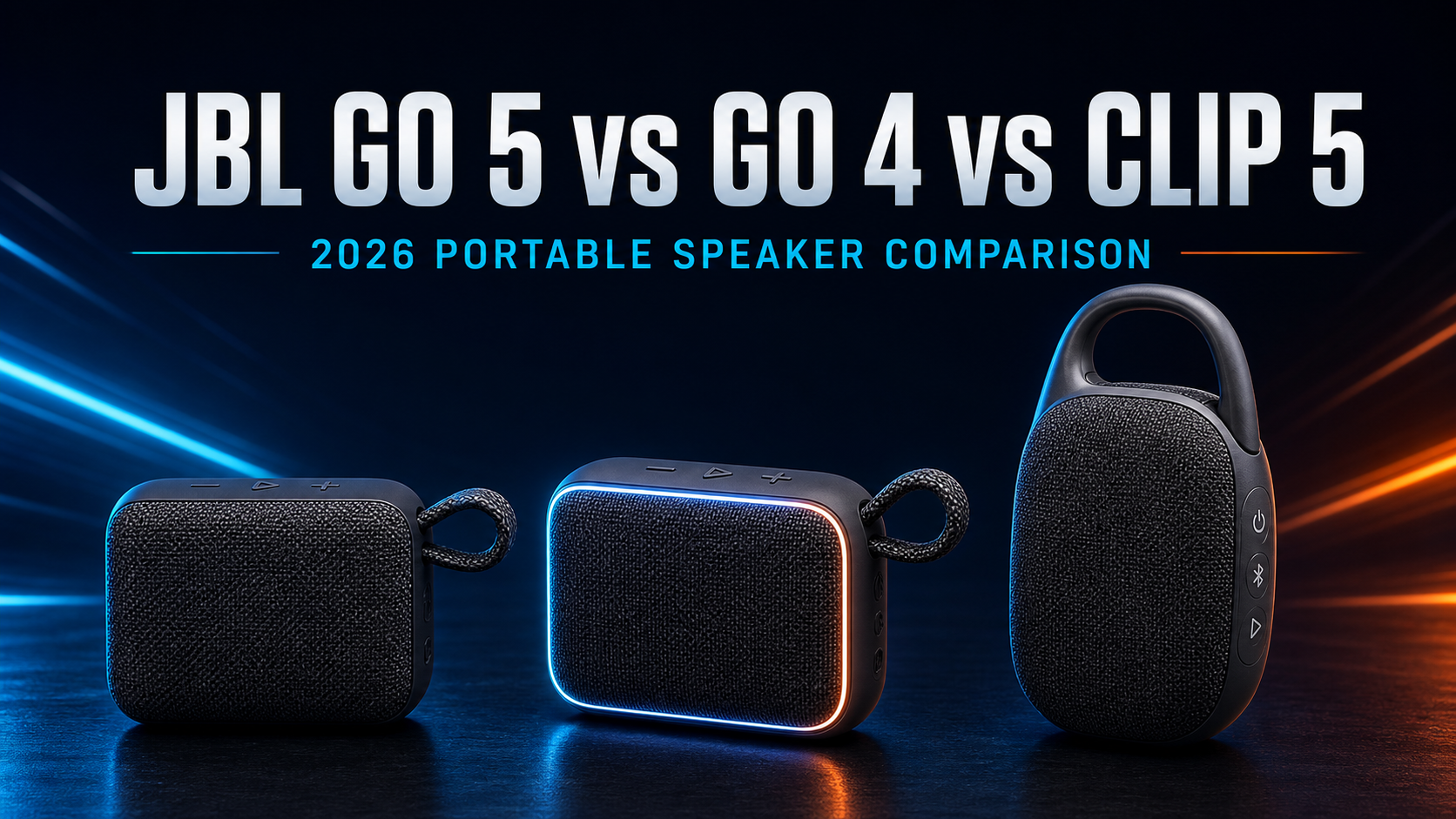
The short answer: buy the JBL Go 5 if you want the newest pocket-size model, USB-C lossless audio, IP68 protection, and ambient lighting. Buy the JBL Go 4 if minimum weight and the lowest price matter most. Buy the JBL Clip 5 if you want a proper carabiner, longer battery life, and more rated output for hiking or all-day outdoor use.
This JBL Go 5 vs Go 4 vs Clip 5 comparison is based on official U.S. specifications, current Amazon.com product data, and manufacturer pages checked on August 30, 2026. It is not presented as a hands-on loudness, sound-quality, or drop test.
This article contains affiliate links. If you buy through one of these links, SEFP Journal may receive a commission at no additional cost to you.
- Quick verdict
- Why compare Go 5, Go 4, and Clip 5?
- JBL Go 5 vs Go 4 vs Clip 5 specifications
- The biggest difference is how you carry them
- Go 5 vs Go 4: is the new model worth it?
- Go 5 vs Clip 5: pocket speaker or outdoor speaker?
- Battery life and charging
- Waterproof ratings: IP68 vs IP67
- Sound and output: what the specs can tell you
- USB-C audio, Bluetooth, and Auracast
- Which is best for travel, shower, beach, and hiking?
- Price and value
- Who should buy JBL Go 5?
- Who should buy JBL Go 4?
- Who should buy JBL Clip 5?
- Final verdict
- Frequently asked questions
- Sources and verification date
Quick verdict
- Best new pocket speaker: JBL Go 5. It adds Bluetooth 6.0, IP68 protection, a drop-proof claim, USB-C lossless audio, AirTouch stereo pairing, ambient edge lighting, and an 8-hour standard battery claim.
- Best budget and lightest option: JBL Go 4. It weighs about 0.19 kg, has IP67 protection, Auracast, app EQ, and up to 7 hours of standard playback. It remains the sensible buy when the discount is large.
- Best for hiking and backpacks: JBL Clip 5. Its large integrated carabiner is more useful than the small loops on the Go models. It also has the highest rated output and longest battery claim here.
- Best for a desk or hotel room: JBL Go 5 or Go 4. Their wide, low shape is easier to place on a small flat surface.
- Best battery life: JBL Clip 5. JBL lists up to 12 hours normally and 15 hours with Playtime Boost.
Why compare Go 5, Go 4, and Clip 5?
These are three of JBL’s smallest current portable speakers, and their prices often overlap during promotions. The model names do not explain the practical differences:
- Go 5 is the newest palm-size model and the most feature-rich of the two Go speakers.
- Go 4 is lighter and often cheaper, but loses some of the Go 5’s new features.
- Clip 5 is taller, heavier, and built around a large integrated carabiner.
Amazon demand makes this a commercially relevant comparison. On August 30, 2026, Amazon.com listed Go 4 at No. 5, Go 5 at No. 8, and Clip 5 at No. 9 in Portable Bluetooth Speakers. Rankings change frequently, so treat them as a dated demand signal rather than a permanent quality score.
Search results also show separate Go 5 vs Go 4 and Go 4 vs Clip 5 comparisons, while a complete three-way buying guide is less common. The useful question is not simply which speaker is newest. It is whether you need pocket size, the lowest price, or a carabiner and longer runtime.



JBL Go 5 vs Go 4 vs Clip 5 specifications
| Feature | JBL Go 5 | JBL Go 4 | JBL Clip 5 |
|---|---|---|---|
| Official U.S. price checked Aug. 30, 2026 | $54.95 | $49.95 | $79.95 regular; official sale observed at $59.95 |
| Design | Palm-size speaker with small integrated loop | Palm-size speaker with small integrated loop | Taller speaker with large integrated carabiner |
| Rated output | 4.8 W RMS | 4.2 W | 7 W |
| Transducer | 45 mm | Not specified on the U.S. product page | 45 mm |
| Standard battery claim | Up to 8 hours with light effect off | Up to 7 hours | Up to 12 hours |
| With Playtime Boost | Up to 10 hours | Up to 9 hours | Up to 15 hours |
| Charging time | 3 hours | 3 hours | 3 hours |
| Bluetooth | 6.0 | 5.3 | 5.3 |
| Protection | IP68 waterproof/dust-proof; drop-proof claim | IP67 waterproof/dustproof | IP67 waterproof/dustproof |
| Dimensions | 101 × 77.4 × 43 mm | 94 × 78 × 42 mm | 86 × 135 × 46 mm |
| Weight | 0.23 kg / 0.51 lb | 0.19 kg / about 0.42 lb | 0.285 kg / 0.628 lb |
| Auracast | Yes | Yes | Yes |
| Same-model stereo | AirTouch for two Go 5 speakers | Two Go 4 speakers | Two Clip 5 speakers |
| USB-C audio | Yes, compatible lossless playback | Not listed | Not listed |
| App | JBL Portable; 7-band EQ and light themes | JBL Portable; customizable EQ | JBL Portable; customizable EQ |
| Charging cable included | No | Yes | Yes |
| Best for | New features, desk, pool, travel | Budget, lowest weight, simple portability | Backpack, hiking, longer days outdoors |
Battery figures are manufacturer maximums. Actual runtime varies with volume, content, connection, EQ, temperature, and features such as lighting or Playtime Boost.
JBL’s Go 5 product page and its downloadable specification sheet currently list different frequency-response ranges. Because two official sources disagree, this article does not use that number to declare a sound-quality winner.
The biggest difference is how you carry them
JBL Go 5: pocket size with a small loop
Go 5 measures about 101 mm wide and weighs 0.23 kg. It remains small enough for a jacket pocket, small travel pouch, nightstand, or crowded desk. Its integrated loop can help you grab or hang it, but it is not the same as Clip 5’s wide carabiner.
The Go 5 is slightly wider and heavier than Go 4. That increase buys newer electronics, a larger battery, edge lighting, and stronger environmental protection. It is still a pocket speaker rather than a backpack-first design.
JBL Go 4: the lightest and simplest carry
Go 4 is the lightest model in this comparison at roughly 0.19 kg. Its body is a little narrower than Go 5, and it keeps the compact integrated loop. If every ounce matters or you want a speaker that disappears into a small bag, Go 4 has the clearest portability advantage.
The compromise is that the loop is useful for a finger, hook, or cord but does not replace Clip 5’s built-in carabiner. Buyers searching for a JBL speaker that clips directly to a backpack should start with Clip 5.
JBL Clip 5: a carabiner is the product
Clip 5 is taller and heavier, but its wide integrated carabiner changes how you use it. It can attach to a backpack strap, belt loop, gear loop, or other suitable anchor without adding a separate clip.
That makes Clip 5 the logical option for hiking, travel days, and outdoor work. The tradeoff is pocketability. At 135 mm tall and 0.285 kg, it is still very portable but less discreet than either Go model.
Carry winner: Go 4 for minimum size and weight; Clip 5 for attachment; Go 5 for the best middle ground.
Go 5 vs Go 4: is the new model worth it?
Go 5 is more than a cosmetic update, although the basic size and purpose remain similar.
The main upgrades are:
- output increases from 4.2 W to 4.8 W on the specification sheets;
- standard battery life increases from up to 7 to 8 hours;
- protection moves from IP67 to IP68, and JBL adds a drop-proof claim;
- Bluetooth moves from version 5.3 to 6.0;
- USB-C lossless audio is added for compatible sources and content;
- AirTouch can pair two Go 5 speakers by bringing them together;
- ambient edge lighting and selectable light themes are added;
- the JBL Portable app offers a 7-band EQ for Go 5;
- Go 5 supports newer SBC, AAC, and LC3 format listings.
Those features make Go 5 the better long-term purchase when the price difference is small. IP68 gives it a stronger official water-and-dust rating, USB-C audio adds a wired listening option, and the extra hour of standard battery life is useful on travel days.
Go 4 still makes sense when it is substantially cheaper. It already includes IP67 protection, Auracast, stereo pairing with another Go 4, app EQ, and Playtime Boost. It is also about 40 grams lighter.
Do not assume the 0.6 W rating difference proves that Go 5 will sound dramatically louder in every room. Output ratings, tuning, distortion limits, placement, and content all affect perceived loudness. A specification-based comparison can identify the higher rating but cannot replace controlled measurements.
Go 5 vs Clip 5: pocket speaker or outdoor speaker?
Go 5 is newer and has more advanced connectivity, but Clip 5 remains the stronger choice for specific outdoor needs.
Clip 5 has a 7 W rating versus Go 5’s 4.8 W rating. It also claims up to 12 hours of standard playback instead of 8 hours. Its 1400 mAh-equivalent battery is larger than Go 5’s 1000 mAh-equivalent battery, and the integrated carabiner is much more useful on a backpack.
Go 5 responds with lower weight, a smaller body, IP68 instead of IP67, a drop-proof claim, Bluetooth 6.0, USB-C lossless audio, lighting, and AirTouch pairing. It is better for a desk, hotel room, pool area, or short trip where compactness matters more than maximum runtime.
Choose Clip 5 for hikes, long beach days, and bag attachment. Choose Go 5 for new features and pocketability.
Battery life and charging
Battery life is one of the clearest differences.
- Go 5: up to 8 hours with lighting off, or 10 hours with Playtime Boost.
- Go 4: up to 7 hours normally, or 9 hours with Playtime Boost.
- Clip 5: up to 12 hours normally, or 15 hours with Playtime Boost.
All three list a three-hour charging time. Playtime Boost extends runtime by changing the speaker’s performance settings, so it should not be treated as free extra battery with identical sound and output behavior.
Clip 5 is the battery winner. Go 5 offers a one-hour standard improvement over Go 4, but buyers who routinely stay away from power for a full day will get more margin from Clip 5.
There is also a box-content detail that is easy to miss: JBL says Go 5 does not include a USB cable, while the official Go 4 and Clip 5 pages list a Type-C cable in the box. Most buyers already own a compatible cable, but it matters for a gift or first Bluetooth speaker.
Waterproof ratings: IP68 vs IP67
Go 5 is rated IP68, while Go 4 and Clip 5 are rated IP67. All three are positioned as waterproof and dustproof portable speakers, but Go 5 carries the stronger numerical rating and an additional drop-proof claim from JBL.
An IP rating is not a general promise against every type of damage. Saltwater, pool chemicals, wet charging ports, high-pressure jets, and drops onto irregular surfaces can introduce different risks. Follow JBL’s care instructions, allow the port area to dry, and do not charge a wet device.
The IP68 rating makes Go 5 the best specification-based choice around water. Clip 5 may still be easier to keep away from a wet or sandy surface because it can hang from a secure attachment point.
Sound and output: what the specs can tell you
Clip 5 has the highest output rating at 7 W. Go 5 is rated at 4.8 W, and Go 4 at 4.2 W. Those numbers suggest Clip 5 has more amplifier headroom on paper, but they do not fully describe bass extension, tonal balance, maximum clean volume, or how a speaker sounds outdoors.
Placement matters with very small speakers. A flat, stable surface can reinforce sound differently from a speaker hanging freely from a bag. The listening distance and ambient noise often matter more than small differences in the specification table.
This article therefore does not claim that one speaker has better sound quality based only on wattage. For buyers who prioritize sound over pocket size, a larger JBL model such as Flip 7 or Charge 6 is a different category and may be more appropriate.
USB-C audio, Bluetooth, and Auracast
Go 5 is the connectivity leader. JBL lists Bluetooth 6.0, SBC/AAC/LC3 support, and lossless playback through USB-C with compatible content and services. Go 4 and Clip 5 use Bluetooth 5.3 and do not list USB-C audio on their U.S. product pages.
All three support Auracast. This lets compatible JBL speakers join a wider multi-speaker playback group. It does not mean every mixed-model combination becomes a true left/right stereo pair.
For stereo, JBL’s product descriptions specify matching pairs: two Go 5 speakers, two Go 4 speakers, or two Clip 5 speakers. Go 5 also adds AirTouch, which starts stereo pairing by bringing two Go 5 units together.
If you search for “can JBL Go 5 connect to Go 4 or Clip 5,” the cautious answer is: they share Auracast for compatible multi-speaker playback, but buy two of the same model if guaranteed left/right stereo is the goal.
Which is best for travel, shower, beach, and hiking?
Best for air travel and hotel rooms: Go 4
Go 4 is the lightest and often the least expensive. It is easy to pack, has enough battery for typical hotel use, and does not add lighting that some buyers may not need.
Best for a shower or pool area: Go 5
Go 5 has the strongest official IP rating and a drop-proof claim. Keep it outside direct high-pressure water, follow JBL’s safety instructions, and never charge it while wet.
Best for hiking and backpacks: Clip 5
The integrated carabiner and longer battery specification make Clip 5 the most practical outdoor choice. Confirm that the attachment point is secure before moving.
Best for a desk: Go 5
Go 5’s compact horizontal body, USB-C audio option, and app EQ make it the most versatile desk speaker here. The ambient edge light can be disabled if you prefer a less visible setup.
Price and value
On JBL’s U.S. pages checked August 30, 2026, Go 5 was listed at $54.95 and Go 4 at $49.95. Clip 5 showed a $79.95 regular price with a $59.95 official sale on the viewed color. Prices, colors, coupons, sellers, and stock change frequently.
At those prices, Go 5 is the easiest value recommendation. A $5 difference over Go 4 is small compared with the added IP68 rating, USB-C audio, extra battery hour, Bluetooth 6.0, lighting, and AirTouch.
Go 4 becomes more attractive when discounted well below Go 5. Clip 5 is worth paying more for when the carabiner and 12-hour standard battery claim solve real needs. If you will never clip it to anything, the extra size and weight may not justify the premium.
The Amazon product cards below show the current offer rather than locking the buying decision to one temporary price.
Who should buy JBL Go 5?
Choose Go 5 if most of these statements match you:
- You want the newest small JBL speaker.
- IP68 protection and a drop-proof claim matter.
- You want USB-C audio or Bluetooth 6.0.
- You prefer a pocket-size body over a large carabiner.
- An 8-hour standard battery claim is enough.
- The price is close to Go 4.
Who should buy JBL Go 4?
Choose Go 4 if most of these statements match you:
- You want the lightest option.
- You found it at a meaningful discount.
- IP67, Bluetooth 5.3, Auracast, and app EQ already cover your needs.
- You do not care about lighting, USB-C audio, or AirTouch.
- You want a simple travel or hotel-room speaker.
Who should buy JBL Clip 5?
Choose Clip 5 if most of these statements match you:
- You want a built-in carabiner for a backpack or belt loop.
- Battery life matters more than minimum weight.
- You prefer the highest rated output in this comparison.
- You hike, camp, bike, or spend long days outdoors.
- IP67 protection is sufficient.
- You are willing to carry a taller and heavier speaker.
Final verdict
JBL Go 5 is the best overall buy, Go 4 is the budget and low-weight choice, and Clip 5 is the best outdoor carry speaker.
Go 5 is the default recommendation when prices are close. Its new features are practical rather than purely cosmetic: stronger environmental protection, longer standard battery life, USB-C audio, Bluetooth 6.0, AirTouch, and a more flexible app equalizer.
Go 4 remains relevant because it is lighter and can be much cheaper during sales. Clip 5 is not simply a more expensive Go. Its carabiner, 7 W rating, and longer runtime target buyers who attach a speaker to gear and keep it away from a charger for longer.
Frequently asked questions
Is JBL Go 5 better than Go 4?
Go 5 has the stronger specification set: IP68, Bluetooth 6.0, USB-C lossless audio, AirTouch, lighting, 4.8 W output, and up to eight hours of standard playback. Go 4 is lighter and may be the better value when heavily discounted.
Is JBL Go 5 louder than Go 4?
Go 5 has a higher rated output, 4.8 W versus 4.2 W. That does not by itself prove a large real-world loudness difference because tuning, distortion limits, placement, and content also matter.
Is JBL Clip 5 better than Go 5?
Clip 5 is better for a backpack, longer battery life, and higher rated output. Go 5 is smaller, lighter, rated IP68, and has newer connectivity including USB-C audio and Bluetooth 6.0.
Can JBL Go 5 connect to Go 4 or Clip 5?
All three support Auracast for compatible multi-speaker playback. JBL describes true stereo pairing with two matching speakers, so buy two of the same model if left/right stereo is important.
Does JBL Go 5 include a charging cable?
No. JBL’s official U.S. product page says a USB cable is not included. Go 4 and Clip 5 list a Type-C cable in the box.
Which has the best battery life?
Clip 5 has the highest manufacturer claim: up to 12 hours normally and 15 hours with Playtime Boost. Go 5 claims 8/10 hours, and Go 4 claims 7/9 hours.
Which is best for a backpack?
Clip 5. Its large integrated carabiner is designed for attachment. Go 5 and Go 4 have smaller loops but not the same wide clipping mechanism.
Which is best for the shower?
Go 5 has the strongest official rating at IP68. Water resistance does not make wet charging safe, and you should follow JBL’s care and placement instructions.
Sources and verification date
Specifications, U.S. prices, Amazon rankings, product names, images, and availability were checked on August 30, 2026.
- JBL Go 5 official U.S. product page
- JBL Go 5 official specification sheet
- JBL Go 4 official U.S. product page
- JBL Clip 5 official U.S. product page
- JBL Clip 5 official specification sheet
- Amazon.com JBL Go 5
- Amazon.com JBL Go 4
- Amazon.com JBL Clip 5
Amazon rankings, prices, coupons, sellers, colors, and stock can change at any time. Check the product page for the current offer before buying.