Affiliate disclosure: As an Amazon Associate, SEFP Journal earns from qualifying purchases. Product cards link to Amazon.com listings for the United States.
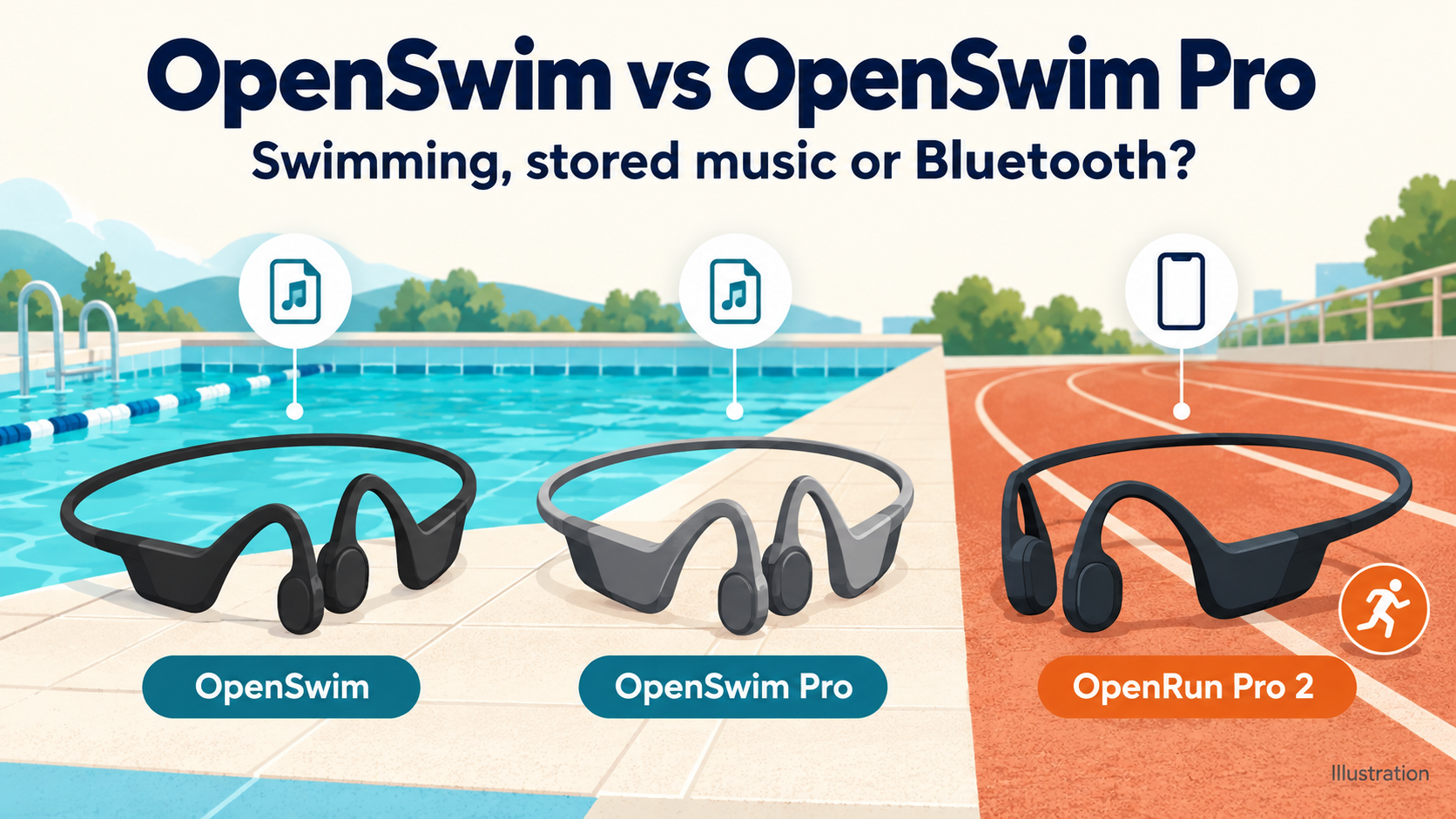
For Shokz OpenSwim vs OpenSwim Pro, choose by where your music comes from. OpenSwim is a 4GB local-file player with no Bluetooth. OpenSwim Pro adds 32GB storage and Bluetooth for use on land, but swimming still requires stored files in MP3 Mode. If you only want a running headset, the OpenRun Pro 2 is a separate land-use option, not a swimming substitute.
One easily missed detail: Pro advertises up to nine hours in Bluetooth Mode, but up to six hours in MP3 Mode. The original OpenSwim advertises up to eight hours of local playback. Paying for Pro does not buy a longer published swimming-mode runtime.
This is a comparison of manufacturer specifications, not a hands-on swimming or listening review. We have not tested fit, battery duration, sound leakage or water resistance. Official US information was checked October 30, 2026. The featured image is an explanatory illustration, not a photograph or exact hardware drawing.
- OpenSwim vs OpenSwim Pro, with OpenRun Pro 2 for land use
- Which one fits your listening routine?
- OpenSwim: a focused offline player
- OpenSwim Pro: more storage, plus Bluetooth outside the pool
- Why Bluetooth and a waterproof rating do not solve streaming underwater
- Can you use Spotify or Apple Music downloads?
- Loading files and keeping the correct cable
- When OpenRun Pro 2 is the more relevant comparison
- Before ordering: check the exact unit and care instructions
- Official sources and user guides
OpenSwim vs OpenSwim Pro, with OpenRun Pro 2 for land use
| Feature | OpenSwim | Swim Pro | Run Pro 2 |
|---|---|---|---|
| Intended use here | Stored music while swimming | Swimming + Bluetooth on land | Land workouts only |
| Local storage | 4GB | 32GB | None |
| Bluetooth | No | Yes, above water | Yes, above water |
| Underwater playback | Local files | Local files in MP3 Mode | Not for swimming |
| Local runtime, up to | 8 hours | 6 hours | Not applicable |
| Bluetooth runtime, up to | Not applicable | 9 hours | 12 hours |
| US published rating* | IP68 | IP68 | IP55 |
| Published weight | 30g | 27.3g | 30.3g, Standard |
| Headset charging | USB cradle | 4-pin magnetic cable | USB-C port |
| Full charge, approx. | 2 hours | 1.5 hours | 1 hour |
Battery figures are manufacturer maximums, not results measured under identical conditions. *The checked US pages list IP68 for both swim models. Older or regional material may use IPX8 wording; follow the manual and limits for your exact unit. A shared rating does not establish unlimited immersion, diving approval or identical care instructions.


 ポチップ
Dry-land alternative only: the next product is not suitable for swimming.
 ポチップ
Which one fits your listening routine?
| Your routine | Start with | Check first |
|---|---|---|
| Pool sessions using your existing audio files | OpenSwim | 4GB covers your library; computer transfer is practical. |
| Pool sessions plus phone streaming on land | OpenSwim Pro | Swimming still uses files; Bluetooth is for above-water listening. |
| A larger offline library | OpenSwim Pro | Storage capacity does not guarantee every file format or encoding will play. |
| Runs and calls, without swimming | OpenRun Pro 2 | IP55 is not a swimming rating; choose Standard/Mini fit correctly. |
| Only subscription-app downloads, no transferable files | Resolve the music-source requirement before buying | An offline app playlist is not automatically an MP3 library you can copy. |
This decision works best before comparing sale prices. A lower price on OpenSwim is useful only if you are willing to load files. Pro’s extra cost can be worthwhile for switching to a phone on land, but that feature does not turn a pool session into a Bluetooth-streaming session.
OpenSwim: a focused offline player
The original OpenSwim stores audio on the headset and does not pair with a phone over Bluetooth. Its appeal is a dedicated swim library without adding Bluetooth functions you may not use. Shokz lists 4GB storage, approximately two-hour charging and up to eight hours of playback.
Decide whether 4GB is enough from the files you actually own. A short rotation of training music may fit easily, while a large lossless library occupies much more space. There is no useful universal song count without assuming file sizes. Copy a representative folder’s size into your buying decision instead of relying on a headline track count.
Its USB charging cradle is part of the ownership cost. Check that the exact listing includes the correct cradle; do not assume a generic USB-C lead plugs into the headset. OpenSwim is also not a phone-call headset: its local-player role is the point of the product.
OpenSwim Pro: more storage, plus Bluetooth outside the pool
Pro expands storage to 32GB and adds Bluetooth connectivity for above-water listening and calls. It is the more flexible shortlist if you want to load a swim playlist, leave the pool, then switch to your phone’s audio. The published weight is 27.3g, compared with 30g for OpenSwim; that does not establish which frame will fit you better.
The relevant battery comparison for swimming remains eight hours versus six hours, not eight versus nine. Real duration depends on use and conditions. If a local-playback session is the main requirement, weigh the storage and land-use features against that difference instead of treating “Pro” as an upgrade on every specification.
Shokz’s support page also describes playlist features tied to app updates. Check the current app and firmware instructions before assuming a video about an older release describes today’s controls. We have not verified a particular app/firmware combination or reproduced playlist behavior.
ポチップ
Why Bluetooth and a waterproof rating do not solve streaming underwater
Shokz explicitly limits OpenSwim Pro’s underwater playback to MP3 Mode because water disrupts Bluetooth signals. Pairing successfully on the pool deck does not establish that a phone or watch will maintain playback once the headset is submerged. More storage and newer Bluetooth are different features.
Plan the swim as a local-file session: prepare the audio on the headset before getting in. If live phone streaming is your non-negotiable requirement, these swim models do not meet that requirement underwater. Buying a more expensive Bluetooth version without changing that expectation would leave the central problem unsolved.
Can you use Spotify or Apple Music downloads?
Shokz’s OpenSwim FAQ says subscription streaming services are not a source of directly transferable music files. Saving an album for offline playback inside an app does not automatically produce supported files that the headset can read. Pro’s Bluetooth capability helps with streaming above water, not with copying an app’s private download library into MP3 Mode.
Use compatible audio files that you can legitimately transfer. Check the file’s encoding as well as its extension: a supported container name does not promise support for every bit depth, sample rate or protected file. If you are unsure, confirm the source and model requirements before paying for extra storage. We do not recommend or provide a workaround for protected subscription downloads.
Loading files and keeping the correct cable
The official S710 user guide describes connecting OpenSwim Pro to a computer with its supplied magnetic cable, opening the SWIM PRO drive and copying audio files or folders. Complete the transfer and eject the drive before unplugging. Shokz’s support FAQ says Bluetooth file transfer is not supported.
OpenSwim’s cradle and Pro’s four-pin magnetic cable are different accessories. Keep the supplied part with the headset and verify a replacement against the exact model. The connector on the computer end can also vary by package or revision; a retailer’s mention of USB-C does not mean the Pro headset itself has a standard USB-C socket like OpenRun Pro 2.
A practical pre-purchase check is whether you can use a computer for transfers, have suitable audio files, and can carry the model-specific charging accessory. If those steps are inconvenient, account for them now. Storage capacity is only useful when the loading process fits your routine.
When OpenRun Pro 2 is the more relevant comparison
For running and other land workouts, OpenRun Pro 2 lists up to twelve hours of Bluetooth playback and a conventional USB-C charging port. It has no onboard music storage and is rated IP55. It is not suitable for swimming, even though it shares an open-ear neckband shape with the swim products.
Choose it for a land-use requirement, not as a cheaper route to underwater playback. Its Standard and Mini sizes also deserve a fit check. If you are deciding between the land models, our OpenRun vs OpenRun Pro 2 guide covers their charging, water-resistance and fit differences.
ポチップ
Before ordering: check the exact unit and care instructions
For a swim-only shortlist, compare OpenSwim’s offline simplicity with Pro’s larger library and extra land functions. For a running-only shortlist, give priority to a running model’s fit and charging setup. Sound quality, comfort and seal durability are not ranked here because we did not test them. The linked black Standard OpenRun Pro 2 listing includes a reflective strip; that accessory does not change its land-only use.
Read the regional instructions for immersion and cleaning. The US Pro FAQ advises against diving and seawater use, and explains fresh-water care after salt exposure. Treat that restriction as more useful than a generic “waterproof” badge. Let the charging contacts become clean and dry before connecting the correct cable.
Confirm the selected model, color, size, condition, included charging accessory and current seller offer. OpenSwim and OpenSwim Pro are different products; OpenRun Pro 2 is a land-only alternative. The cards intentionally repeat the compared models at decision points rather than adding unrelated accessories or claiming a fixed lowest price.
ポチップ
Not for swimming: compare this option only for land workouts.
ポチップ