As an Amazon Associate I earn from qualifying purchases.
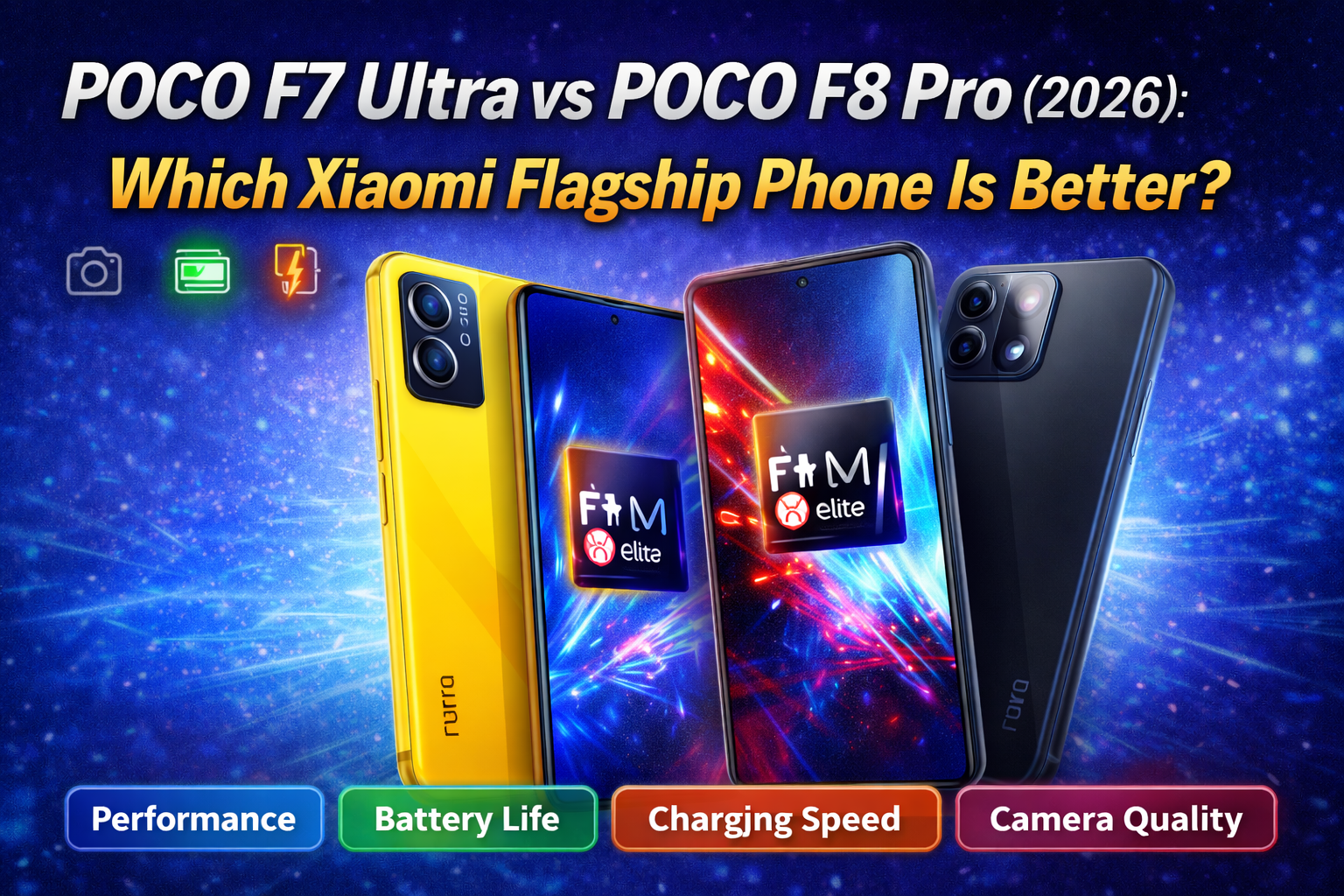
POCO F7 Ultra and POCO F8 Pro both use Qualcomm’s Snapdragon 8 Elite, but they are not interchangeable. The F7 Ultra has the sharper WQHD+ display, 120W wired charging, 50W wireless charging, and a more flexible rear-camera system. The F8 Pro has the larger battery, a smaller display, HyperOS 3, and Sound by Bose.
This comparison is based on Xiaomi and POCO’s published specifications, not a hands-on test. Specifications were checked on August 4, 2026. The article compares the Global versions; memory configurations, network bands, accessories, warranty coverage, and availability can differ by country or retailer.
Check current prices
Use the product cards below to check current availability. Prices are not fixed in this article because marketplace pricing and stock change frequently. Amazon.com listings may be imported Global models, so check network-band compatibility and warranty terms before ordering.



Quick answer
- Choose POCO F7 Ultra if you want a 3200 x 1440 display, 50W wireless charging, or the more versatile camera system.
- Choose POCO F8 Pro if you want the larger 6210mAh battery, HyperOS 3, a slightly smaller 6.59-inch body, or Sound by Bose.
- For raw chipset performance, both use Snapdragon 8 Elite. Cooling design, software version, display workload, and game settings can still affect sustained performance.
POCO F7 Ultra vs POCO F8 Pro specs
| Specification | POCO F7 Ultra | POCO F8 Pro |
|---|---|---|
| Processor | Snapdragon 8 Elite, 3nm | Snapdragon 8 Elite, 3nm |
| Memory and storage | 12GB + 256GB; 16GB + 512GB; LPDDR5X; UFS 4.1 | 12GB + 256GB; 12GB + 512GB; LPDDR5X; UFS 4.1 |
| Display | 6.67-inch Flow AMOLED, 3200 x 1440, up to 120Hz | 6.59-inch AMOLED, 2510 x 1156, up to 120Hz |
| Battery | 5300mAh typical | 6210mAh typical |
| Wired charging | 120W HyperCharge | 100W HyperCharge |
| Wireless charging | 50W HyperCharge | Not supported |
| Rear cameras | 50MP main with OIS; 50MP floating telephoto with OIS; 32MP ultrawide | 50MP main with OIS; 50MP 60mm telephoto; 8MP ultrawide |
| Front camera | 32MP | 20MP |
| Water and dust resistance | IP68 | IP68 |
| Software at launch | Xiaomi HyperOS 2 | Xiaomi HyperOS 3 |
| Audio | Stereo speakers | Symmetrical stereo speakers, Sound by Bose |
Sources: POCO F7 Ultra Global product page, POCO F7 Ultra specifications, POCO F7 Ultra official FAQ, POCO F8 Pro Global product page, POCO F8 Pro specifications, and POCO F8 Pro official FAQ. Checked August 4, 2026.
Performance and gaming
Both phones use Snapdragon 8 Elite with LPDDR5X memory and UFS 4.1 storage. On paper, neither model has a generational chipset advantage. The F7 Ultra is sold in 12GB/256GB and 16GB/512GB configurations, while the F8 Pro Global specifications list 12GB/256GB and 12GB/512GB.
The official product pages describe different cooling systems, but published specifications alone cannot establish which phone sustains higher frame rates in a particular game. Game version, graphics settings, ambient temperature, battery level, and performance mode all affect the result. This article therefore does not claim measured gaming or thermal superiority without a controlled test.
Performance verdict
Choose by display, battery, charging, camera, software, and size rather than expecting a large difference in peak processor class. Buyers who need 16GB RAM should note that the F7 Ultra Global specification includes a 16GB/512GB configuration, whereas the F8 Pro Global page lists 12GB RAM configurations.
Display and design
The F7 Ultra has a 6.67-inch WQHD+ Flow AMOLED panel with a 3200 x 1440 resolution and refresh rate up to 120Hz. The F8 Pro uses a slightly smaller 6.59-inch AMOLED panel with a 2510 x 1156 resolution and refresh rate up to 120Hz.
The F7 Ultra therefore has the higher published pixel resolution. The F8 Pro’s smaller panel and lower resolution may appeal to buyers who prioritize a more compact footprint, but battery-life effects cannot be quantified from specifications alone.
Both models carry an IP68 rating under the manufacturer’s stated laboratory conditions. Water resistance is not permanent and may decline with wear; liquid damage terms can vary by region.
Display verdict
Pick the F7 Ultra for maximum display resolution. Pick the F8 Pro if a slightly smaller 6.59-inch panel is more important. Color preference, comfort, and outdoor visibility should ideally be checked in person because those judgments are subjective.
Battery and charging
The F8 Pro has the larger published battery: 6210mAh typical versus 5300mAh typical in the F7 Ultra. Capacity alone does not prove a specific number of hours or “two days” of use. Screen brightness, mobile signal, games, camera use, refresh rate, and background apps can substantially change endurance.
Wired charging
The F7 Ultra supports 120W HyperCharge, while the F8 Pro supports 100W HyperCharge. The F8 Pro product page states a 37-minute charge from 1% to 100% under POCO Internal Labs conditions: Top speed mode, screen off, approximately 25 degrees Celsius, and the in-box 100W charger. That result is not presented here as an independent real-world measurement.
Earlier unsourced claims that either phone reaches 50% or a full charge in a particular number of minutes have been removed.
Wireless charging
The POCO F7 Ultra does support 50W wireless HyperCharge. The POCO F8 Pro official FAQ states that it does not support wireless charging or reverse wireless charging. This is one of the clearest practical differences between the two models.
Battery and charging verdict
Choose the F8 Pro for the larger rated battery. Choose the F7 Ultra if 50W wireless charging or the higher 120W wired-charging rating matters more. Actual endurance and charging time depend on conditions and accessories.
Cameras
The F7 Ultra has a 50MP main camera with OIS, a 50MP floating telephoto camera with OIS, and a 32MP ultrawide camera. The F8 Pro has a 50MP main camera with OIS, a 50MP 60mm telephoto camera, and an 8MP ultrawide camera.
The F7 Ultra’s higher-resolution ultrawide and its officially specified OIS on both the main and floating telephoto cameras give it the broader specification sheet. That does not, by itself, prove better night photos, video stabilization, skin tones, or detail in every scene. Those outcomes require matched sample images and controlled testing.
Camera verdict
The F7 Ultra is the stronger choice on published camera hardware and lens flexibility. Buyers who care about image processing should compare full-resolution samples from the same scenes rather than relying on unverified experience-style claims.
Audio and media
POCO markets the F8 Pro with Sound by Bose and symmetrical stereo speakers. That branding is an official feature, but it does not prove that every listener will prefer its sound. Loudness, tuning, spatial presentation, and distortion need controlled measurements or a listening comparison.
The F7 Ultra’s higher-resolution display is its clearest specification advantage for media. The F8 Pro combines a smaller 120Hz display with Bose-branded audio tuning.
Software and regional availability
The F7 Ultra Global specification lists Xiaomi HyperOS 2. The F8 Pro Global specification lists Xiaomi HyperOS 3. Update timing and supported features can differ by region.
Both official Global product pages were live when checked on August 4, 2026. Xiaomi also maintains regional pages, including a UK purchase page for the F8 Pro. Stock, included charger, colors, network bands, eSIM support, and warranty terms can vary. Check the exact regional model number before purchase, especially when buying an imported phone from Amazon.com.
Pros and cons
POCO F7 Ultra
Pros
- 3200 x 1440, 120Hz AMOLED display
- 120W wired and 50W wireless charging
- 50MP main, 50MP telephoto, and 32MP ultrawide rear cameras
- 16GB/512GB configuration listed for the Global version
- IP68 rating
Cons
- Smaller rated battery than the F8 Pro
- Ships with the older HyperOS generation of the two
- Regional availability and imported-model warranty require checking
POCO F8 Pro
Pros
- Larger 6210mAh typical battery
- Snapdragon 8 Elite with UFS 4.1 storage
- HyperOS 3
- 50MP main and 50MP 60mm telephoto cameras
- Sound by Bose and IP68 rating
Cons
- No wireless charging
- Lower display resolution than the F7 Ultra
- 8MP ultrawide camera
- Global specifications list 12GB RAM, not a 16GB option
Which one should you buy?
The POCO F7 Ultra is the better specification-based pick for buyers who prioritize the sharper display, wireless charging, faster rated wired charging, or a more versatile rear-camera setup.
The POCO F8 Pro is the better fit for buyers who prioritize the larger battery, HyperOS 3, a slightly smaller display, and Bose-branded audio tuning.
There is no evidence-based reason to call one the universally “best Xiaomi phone” from this two-model comparison. The decision here is specifically between these two POCO models.
FAQ
Does the POCO F7 Ultra support wireless charging?
Yes. Xiaomi’s official Global specifications list 50W wireless HyperCharge for the POCO F7 Ultra.
Does the POCO F8 Pro support wireless charging?
No. The official POCO F8 Pro FAQ states that wireless charging and reverse wireless charging are not supported.
Which phone has the larger battery?
The F8 Pro has a 6210mAh typical battery. The F7 Ultra has a 5300mAh typical battery. A larger capacity does not guarantee a fixed number of hours under every workload.
Which phone has the sharper display?
The F7 Ultra has the higher published resolution at 3200 x 1440. The F8 Pro is listed at 2510 x 1156. Both support refresh rates up to 120Hz.
Are these phones officially sold in the United States?
The specifications in this article come from Xiaomi’s Global pages. Amazon.com listings may be imported Global models rather than US-authorized retail units. Verify LTE/5G bands, charger type, returns, and warranty coverage before buying.
When were the specifications checked?
The official Global product pages, specification pages, and support FAQs were checked on August 4, 2026.

コメント