Disclosure: As an Amazon Associate I earn from qualifying purchases.
This site is a participant in the Amazon Services LLC Associates Program. As an Amazon Associate, we earn from qualifying purchases.
Why Budget Earbuds Got Good
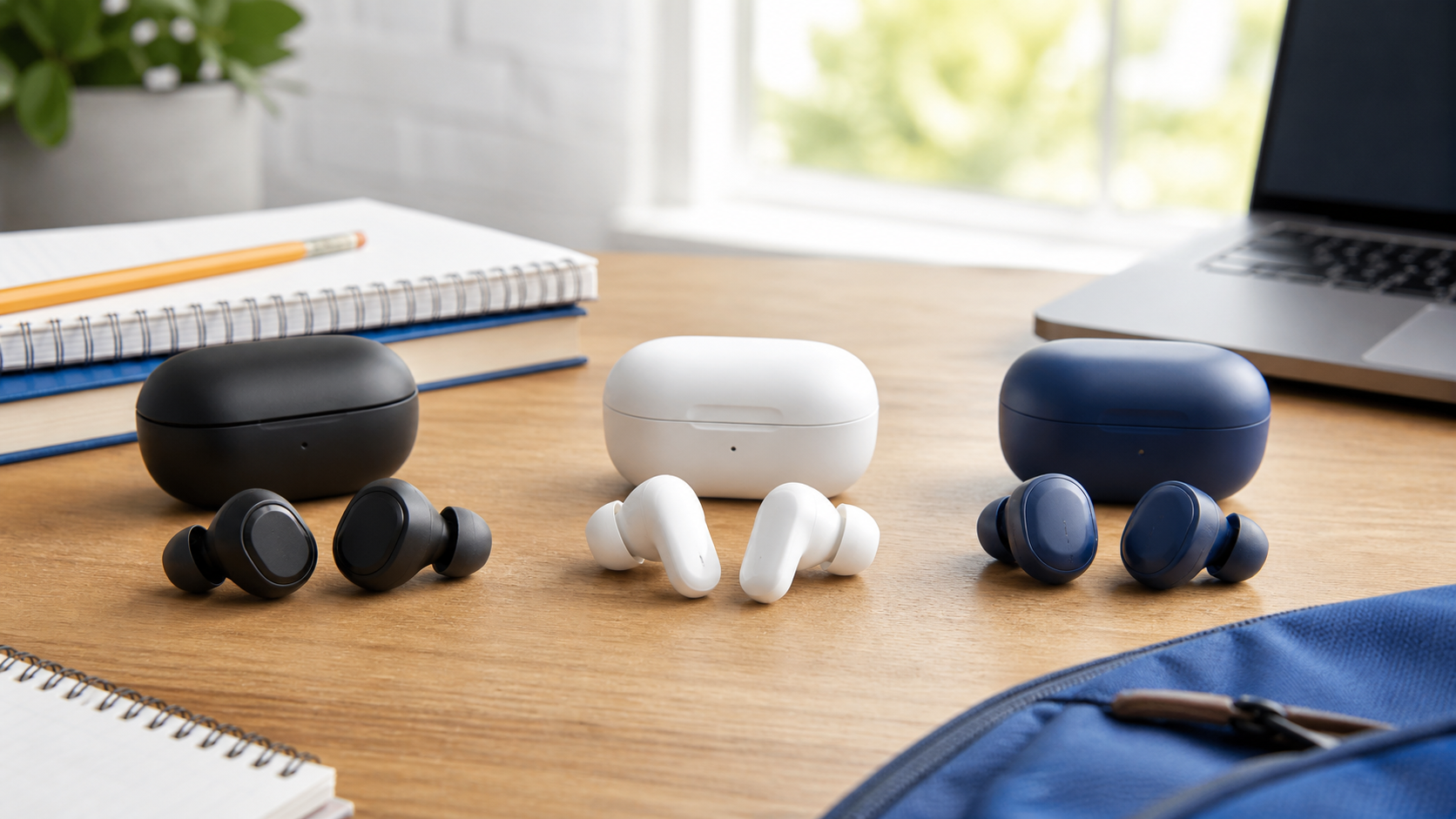
You don’t need to spend $250 on flagship earbuds to get real ANC and good sound anymore. The under-$100 earbuds market has improved dramatically over the last couple of years, and features that used to be exclusive to premium models — adaptive ANC, Hi-Res audio codecs, multipoint connection, and 50+ hour total battery life — are now common well below $100.
Below we compare three current options under $100 that are well suited to studying in noisy dorms or libraries and taking calls between classes. Prices and specs are from the manufacturers and current Amazon listings as of August 2026 and can change, so check the live price before buying.
What actually matters for student use: for most students, the two specs worth prioritizing over pure audio fidelity are noise cancellation (for studying in noisy environments) and total battery life including the case (so you’re not hunting for an outlet between classes). All three picks below cover both reasonably well, so the differences mostly come down to codec support and price.
Quick Comparison Table
| Model | Price | ANC | Battery (earbuds+case) | Codec |
|---|---|---|---|---|
| Soundcore Space A40 | $54.98 | Adaptive ANC, up to 98% noise reduction | 10H / 50H total | Hi-Res (SBC/AAC) |
| EarFun Air Pro 4 | $68.37 | Adaptive Hybrid ANC | ~9H / 52H total | aptX Lossless, LDAC (Hi-Res) |
| Soundcore Liberty 4 NC | $99.99 | Adaptive ANC, 98.5% noise reduction | ~10H / 50H total | Hi-Res, wireless charging |
1. Soundcore Space A40 — Best Value
The Space A40 pairs adaptive ANC (rated to reduce noise by up to 98%) with a long 50-hour total battery life (case included) and wireless charging, all for under $60. A strong pick if ANC and battery life matter more to you than premium codecs.
Who it’s for: Students who mainly want quiet in a noisy dorm, library, or shared study space and don’t have an audiophile-grade phone or DAC to take advantage of higher-end codecs anyway. The wireless charging case is a nice touch if you already have a charging pad on your desk.
- Strong ANC for the price
- 50H total battery life with the case
- Wireless charging case
- No aptX Lossless or LDAC support
- Case is a bit bulkier than the other two

Soundcore Space A40 Adaptive ANC Earbuds

 ポチップ
ポチップ
2. EarFun Air Pro 4 — Best Sound Quality
The Air Pro 4 is the pick for students who care about audio fidelity: it supports Qualcomm aptX Lossless and LDAC (Hi-Res codecs usually reserved for pricier earbuds), Snapdragon Sound, and a 6-mic array for cleaner calls. Rated battery life is about 52 hours total with the case.
Who it’s for: Students who listen critically — music majors, anyone who’s picky about audio quality, or anyone with a phone that supports aptX/LDAC and wants to actually hear the difference. The 6-mic array also makes this a good pick if you take a lot of calls or Zoom meetings from noisy shared spaces.
- aptX Lossless + LDAC — rare at this price
- 6-mic array for clearer calls
- Adaptive hybrid ANC
- Single-earbud runtime is shorter than the Space A40
- Needs a compatible phone/DAC to get the full benefit of Lossless audio — most iPhones and some Android phones won’t take advantage of it

EarFun Air Pro 4 Wireless Earbuds

3. Soundcore Liberty 4 NC — Best ANC + Features
The Liberty 4 NC sits at the top of this comparison at $99.99, with 98.5% noise reduction, adaptive ANC that reacts to your environment, Hi-Res sound, and wireless charging. If you want the most complete feature set under $100, this is it.
Who it’s for: Students who want the strongest noise cancellation of the three and are willing to spend closer to $100 to get it, without stepping up to a $200+ flagship model.
- Best ANC of the three
- Wireless charging case
- Hi-Res sound support
- Most expensive of the three picks here
- Feature gains over the Space A40 are incremental for casual listeners

Soundcore Liberty 4 NC Wireless Earbuds
 ポチップ
ポチップ
Understanding ANC, Codecs, and Battery Ratings
Active Noise Cancellation (ANC) uses microphones to detect ambient sound and play an inverted sound wave to cancel it out, and it works best on consistent, low-frequency noise like HVAC systems, airplane engines, or background chatter — exactly the kind of noise you’ll encounter in a library, dorm hallway, or shared study space. It’s less effective against sudden, sharp sounds. “Adaptive” ANC, offered by all three earbuds here, means the earbuds continuously adjust the cancellation level based on your environment rather than using one fixed setting.
Audio codecs (SBC, AAC, aptX, LDAC) determine how much audio data is transmitted over Bluetooth and at what quality. SBC is the baseline codec every Bluetooth device supports; AAC is what iPhones use by default; aptX and LDAC are higher-bitrate “Hi-Res” codecs that only make an audible difference if both your earbuds and your phone support them, and if the source audio itself is high enough quality (a compressed Spotify stream on the standard tier won’t sound meaningfully different over LDAC vs AAC).
Battery ratings (like “52H total with case”) are measured under controlled lab conditions, usually at a fixed, moderate volume with ANC either on or off depending on how the manufacturer chooses to report it. Real-world battery life, especially with ANC on and volume higher, typically comes in somewhat lower than the rated figure — treat these numbers as a useful point of comparison between models rather than an exact real-world guarantee.
Frequently Asked Questions
Do I need aptX Lossless or LDAC if I mostly listen on Spotify or Apple Music?
Not really, unless you’re specifically paying for a lossless/Hi-Res streaming tier and have a phone that supports the codec. For standard-quality streaming, the difference between AAC and LDAC is usually inaudible to most listeners, so the EarFun Air Pro 4’s codec advantage matters most if you’re already an audio enthusiast.
Is ANC bad for my hearing if I use it to block out noise instead of turning up the volume?
The opposite is generally true: ANC lets you listen at a lower volume in noisy environments because you’re not competing with background noise, which is easier on your hearing over time than cranking the volume up to overcome ambient sound.
Can I use these earbuds for calls in a noisy dorm or coffee shop?
Yes — all three include multi-mic arrays designed specifically for call clarity in noisy environments, with the EarFun Air Pro 4’s 6-mic setup being the most aggressive about isolating your voice from background noise.
Final Verdict
Best value: the Space A40 if you mainly want strong ANC and long battery life for the least money.
Best sound quality: the EarFun Air Pro 4 if you care about Hi-Res codecs like LDAC and aptX Lossless.
Best all-around: the Liberty 4 NC if your budget stretches to $100 and you want the strongest ANC of the three.
If you’re not sure which matters more to you, default to ANC and battery life over codec support — you’ll notice quiet and a full charge every single day, while Hi-Res codecs only matter in specific listening conditions.
Fit, IP Rating, and Everyday Durability
All three earbuds in this comparison carry an IP55 water and dust resistance rating, which means they can handle sweat, light rain, and being tossed in a bag with some dust, but aren’t designed for swimming or full submersion. That’s a sensible middle ground for campus life — enough protection for walking to class in the rain or a sweaty gym session, without paying extra for waterproofing most students won’t use.
Fit matters just as much as specs for earbuds you’ll wear for hours of studying: all three ship with multiple ear tip sizes, and it’s worth trying each size to get a proper seal, since a poor seal hurts both comfort and the effectiveness of ANC (a loose fit lets outside noise leak in around the passive seal, which ANC alone can’t fully compensate for).
Multipoint Connection: Why It Matters for Students
All three earbuds support multipoint Bluetooth connection, meaning they can stay paired to two devices at once — for example, your laptop and your phone simultaneously. In practice, this means you can be on a Zoom call from your laptop and still get a phone call notification without manually disconnecting and reconnecting, which is a small but genuinely useful convenience for a typical student day split between a laptop for classes and a phone for everything else.
Buying through our links helps support this site at no extra cost. Thank you for your support!